
Vor kurzem teilte der US-amerikanische Psychiater und Psychologe Dr. Michael Hoerger mehrere ausführliche Beiträge in sozialen Medien, wo er das psychische Phänomen der Verdrängung auf den aktuellen Umgang der Gesellschaft mit Corona / der Corona-Pandemie übertrug. Er bezog sich dabei auf das Buch „Psychoanalytic Diagnosis: Understanding personality structure in the clinical process“ von Nancy Williams (Link zum Buch siehe unten).
Michael Hoerger, PhD MSCR MBA, ist international anerkannter Experte für „Psychosoziale Onkologie“ und Pandemiemanagement. Er ist a.o. Professor für Psychologie, Psychiatrie und Onkologie an der Tulane University, Direktor der Palliativmedizinischen Forschung am University Medical Center in New Orleans und Co-Direktor des „Population Health Sciences and Disparities Program“ am Louisiana Cancer Research Center.
Er schreibt:
„As a clinical health psychologist, I notice that many people are using psychological defense mechanisms to downplay the risk of COVID“ – und gibt in der Folge 7 Beispiele für gängige Abwehrmechanismen inklusive Aussagen und Statements, um diese zu illustrieren.
1 – Denial – Pretending a problem does not exist to provide artificial relief from anxiety.
Examples:
“During COVID” or “During the pandemic” (past tense)
“The pandemic is over”
“Covid is mild”
“It’s gotten milder”
“Covid is now like a cold or the flu”
“Masks don’t work anyway”
“Covid is NOT airborne”
“Pandemic of the unvaccinated”
“Schools are safe”
“Children don’t transmit COVID”
“Covid is mild in young people”
“Summer flu”
“I’m sick but it’s not Covid”
Using hospitalization capacity estimates to enact public health precautions (lagging indicator)
Citing mortality estimates rather than excess mortality estimates. Citing excess mortality without adjusting for survivorship bias.
2 – Projection – When someone takes what they are feeling and attempts to put it on someone else to artificially reduce their own anxiety.
Examples:
“Stop living in fear.” (the attacker is living in fear)
“You can take your mask off.” (they are insecure about being unmasked themselves)
“When are you going to stop masking?”
“You can’t live in fear forever.”
3 – Displacement – When someone takes their pandemic anxiety and redirects their discomfort toward someone or something else.
Examples:
“Pandemic of the unvaccinated”
Vax and relax
“How many of them were vaccinated?” (troll comment on Covid deaths or long Covid)
Redirecting anxiety about mitigating a highly-contagious airborne virus by encouraging people to do simple ineffective mitigation like handwashing
Telling people to get vaccinated or take other precautions against the flu or RSV but not mentioning Covid
Peer pressure not to mask
4 – Compartmentalization – Holding two conflicting ideas or behaviors, such as caution and incaution, rather than dealing with the anxiety evoked by considering the incautious behaviors more deeply (hypocrisy)
Examples:
Hospitals and clinicians claim to value health/safety but then don’t require universal precautions
Public health officials claim to value evidence but then give non-evidence based advice (handwashing over masking), obscure or use low-value data over high-quality data (self-reported case counts over wastewater), etc.
Getting a flu vaccine but not a Covid vaccine
Infectious disease conference where people are unmasked
Long Covid and other patient-advocacy meetings where only half the people mask
Not testing because it’s just family
5 – Reaction formation – expressing artificial positive feelings when actually experiencing anxiety
Examples:
“It’s good I got my infection out of the way before the holidays”
“I had Covid but it was mild”
Herd immunity (infections help)
Hybrid immunity (infections help)
“It’s okay because I was recently vaccinated”
“Omicron is milder”
“Building immunity”
6 – Rationalization – Artificially reducing Covid anxiety through a weak justification.
Examples:
“I don’t need to mask because I was recently vaccinated.”
“You’re going to get Covid again and again and again over your life.”
“It’s not Covid because I don’t have a sore throat.”
“It’s not Covid because I took a rapid test 3 days ago.”
“It’s not Covid because I’m vaccinated.”
“I’ve had Covid three times. It’s mild.”
“Nobody else is masking.”
“Nobody else is testing.”
“My roommates don’t take any precautions, so there’s no point in me either.”
Various pseudo-scientific treatments used by the left and right
“Masks recommended” instead of universal precautions
“Seasonal”
7 – Intellectualization – using extensive cognitive arguments to artificially circumvent Covid anxiety
Examples:
Schools denying air cleaners because it “could make children anxious”
Schools not rapid testing this surge because it “could make children anxious”
Service workers told not to mask because it could make clients uncomfortable
“What comorbidities did they have?”
“The vulnerable will fall by the wayside”
Musicians and others holding large indoor events
Hier kann man den theoretischen Hintergrund nachlesen: Die Kapitel zu „Abwehrmechanismen“ („defense mechanisms“) beginnen ab ca. Seite 100.
https://isotis.files.wordpress.com/2016/07/mcwilliams_psychoanalytic_diagnosis.pdf
(Bei obigem Text handelt es sich um Originalstatements von Dr. Hoerger, die zwecks Leserlichkeit leicht gekürzt wurden)
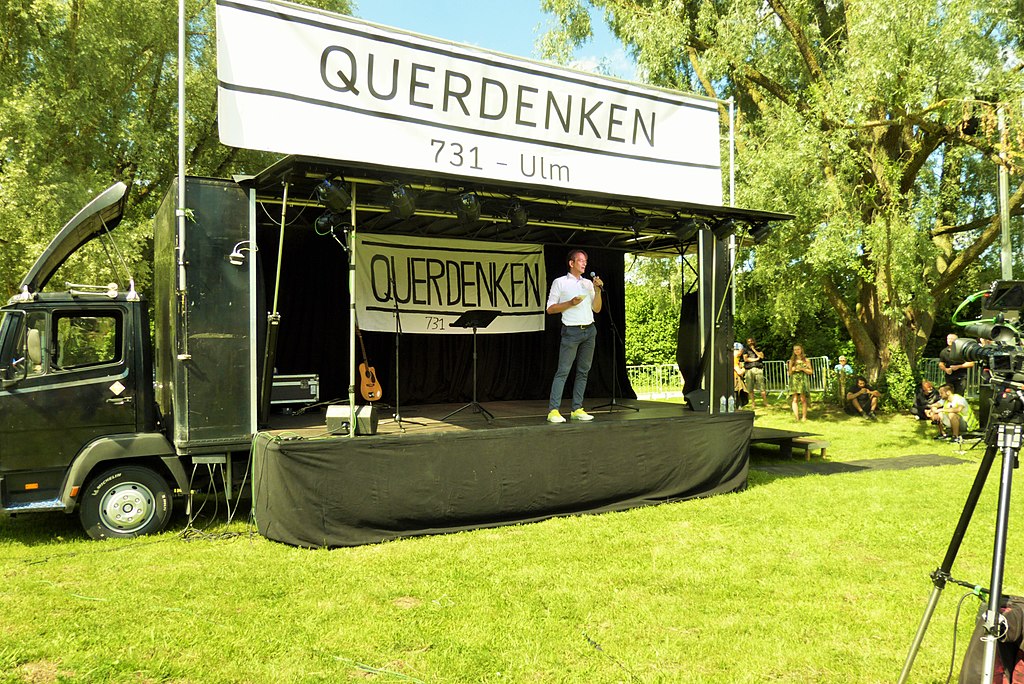
Titelbild: Bodo Schiffmann bei „Querdenken“-Demo https://creativecommons.org/licenses/by-sa/4.0, via Wikimedia Commons



 dasmediumonline.com
Hinterlasse einen Kommentar